
The Treasurer February 2002

The Treasurer February 2002

Editorial

As I write this, many readers may well be in the throes of their latest fad, post-Christmas-binge diet. Others will be quite happy with their new shape and not feel the need for these ridiculous diets and anyway fat is fun…. sorry, getting a bit defensive there. Anyhow, this is all quite appropriate in many ways, as readers may notice that this edition is a slightly slimmed-down version of The Treasurer.

The main reason for this is that, in common with many other publishers, there has been a significant reduction in advertising revenue. As a consequence, there are fewer physical pages and we need to keep the page count down to cut our costs.

Advertising budgets seem still to be there and have not been slashed yet, but many advertisers are waiting to see how the land lies before committing. The media sales team, William Saville and Chantal Feduchin-Pate, has been plugging away at our regular contacts, and indeed finding some new clients, but it is a pretty tough market.

The Treasurer is in a relatively strong position as a market leader and we would like to think that if there is any budget to be spent, it would come to us – we have the best treasurers and the best access to treasurers that there is in the UK. Prospects for the next couple of months are not bad.

Every Editorial of mine seems to have a plea, and this one is no exception. If you are speaking to your bankers, advisers or suppliers, do throw in the odd good word about The Treasurer and the Association. Many of them know us already and appreciate our quality and strengths but there is nothing like the horse’s mouth to reinforce the message.
During the coming year we will also be looking for other opportunities to work with our clients to develop features or supplements, so if you have an idea, whether as a supplier or as a reader, do let me know. I am open to most suggestions.

I have read this month’s Spotlight with interest, as the cashflow involved in paying for production, printing and mailing of the magazine well before we receive any advertising revenue means we have to be careful. I am sure I won’t be the only one to pick up some useful tips on working capital management.

MIKE HENIGAN
Managing Editor
E-learning (TT Feb02 p6)

Oceanus had been struggling recently to understand where all the talk about elearning is leading. This interest was triggered two years ago when a large organisation, gripped by the e-business bug, decreed that all staff, from the top down, should master the intricacies of the e-environment (which proved to range from surfing the net to grappling with data encryption).

Any incipient smugness was immediately sand-bagged as it was announced (in an email, of course) that passing an exam in e-business would be a prerequisite to remaining in the firm! Three strikes and then you were out. To learn about e-business you would need an e-learning package – textbooks could not be contemplated. Then it got better: to show commitment to this new environment, the exam had to be online.

Room for optimism (TT Feb02 p7-8)

Jonathan Loynes of Capital Economics puts interest rate predictions into perspective as the global markets limber up for another year of highs and lows.

marketwatch BONDS | EQUITIES (TT Feb02 p9-10)

These are a selection of bonds announced recently. The details, updated to the middle of last month, were supplied by Thomson Financial Securities data and other sources.

marketwatch HOTLINE (TT Feb02 p11-17)

Welcome to the February Hotline. In response to member comments, the Hotline this month includes two new features, ‘This Month in Treasury’ and ‘Committee Matters’.

All the properties for success (TT Feb02 p18-19)

Joanna Parker, with exclusive access to the key players, analyses both legs of BT’s recent innovative ‘lease and leaseback’ transaction that has helped toward its debt reduction target.

Rising to the challenge (TT Feb02 p22-24)

The second joint survey by the ACT and JPMorgan Fleming highlights the current trends in UK cash management. JPMF’s Peter Knight focuses on the findings.

A global perspective for the CERT CM (TT Feb02 p25)

In October 2001, the first sitting of the association’s new certificate in international cash management took place. Neil Lakeland talked to one of the successful students to find out what his impressions were, and the reasons behind his choice for taking the exam.

The empirical approach (TT Feb02 p26-28)

Recent research provides a greater understanding of whether an optimal governance structure can be applied to companies. Grant Fleming examines the evidence.

The beauty of dealing in exotics (TT Feb02 p29-30)

New pricing systems are enabling companies to make better use of exotics to hedge exposure to movements in FX. David Gershon of superderivatives reports.

The great pensions migration? (TT Feb02 p31-32)

bfinance’s Michael Hart asks whether the big asset management institutions’ fund of funds really have the in-house expertise to guarantee better returns for pensions funds.

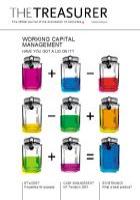
A question of balance (TT Feb02 p34-38)

Chris Hall talks to three leading treasurers about how working capital is managed in their respective firms, the information used and the key processes and controls employed.

The new son of star wars (TT Feb02 p39-40)

An effective working capital management procedure is an essential weapon in today’s often brutal business environment, says Pat Leavy of FTI.

Breaking new boundaries (TT Feb02 p41-43)

Firms are gaining a more accurate view of the underlying health of their business via working capital performance processes, says Malcolm Macdonald of KPMG.

How to avoid the pitfalls (TT Feb02 p44-46)

Staggering amounts of cash are lost every year because of poor working capital practices. David Lock of Rel Consultancy focuses on the ten most common areas to watch out for.

Make swaps for more security (TT Feb02 p47-49)

The rise of the credit derivatives market has been phenomenal, as more and more corporates strive to protect credit risk, say Chris Daniels and Claus Mikkelsen of Barclays Capital.

A benefit to the local community (TT Feb02 p50-52)

Gordon Ibbotson of FSMD explains how housing associations are using working capital techniques in their quest to fund better homes for local communities.

Roles for the 21st century (TT Feb02 p53-55)

Over the past few years, CFOs have seen their roles alter dramatically as businesses make the transition from the old economy to the new, says James Sagner of Sagner/Marks.

Challening times in FX (TT Feb02 p60)

In early January I attended a recorded round-table discussion hosted by Financial News at the London Capital Club. The subject was the uture of the Foreign Exchange Market in the light of the figures from the Bank for International Settlements which showed a decline in turnover of some $300bn a day from the 1998 triennial survey to the 2001 survey.

Managing Corporate Capital (TT Feb02 p61)

The Association’s Autumn Paper for 2001 was given at the Law Society on 1 November. The speaker was Bill Winters, the Global Co-Head of Credit and Rate Markets with JPMorgan.

CERT CM Results (TT Feb02 p62)

The Association of Corporate Treasurers wishes to extend its congratulations to the following people who have passed the Certificate in International Cash Management, October 2001 examinations.

Missing the portfolio plot (TT Feb02 p64)

When my father-in-law Gareth was still alive, he would move after breakfast onto a deep armchair in the lounge with his Western Mail, and from its page of closing stock market prices work out his current wealth long-hand with pencil and paper on the back of brown envelopes.

Email this page to a friend
The International Treasurer's Handbook

Related Terms