
The Treasurer May 2003

The Treasurer May 2003It is early days yet, and there is still plenty that can go wrong, but developments in the conflict in Iraq this month have helped clear up some of the uncertainties surrounding the war. In particular, the prospects of long drawn-out guerilla warfare seem to have receded. There can be little doubt that there will continue to be problems but at least some sort of shape, and hope for a better future, is taking place.

Along with Saddam, one small element of uncertainty dogging the financial markets has now disappeared and other recent events are also showing a certain amount of new-found stability. Firstly, the latest budget (did anyone notice how Saddam cunningly used budget day as cover for his capitulation in Baghdad?): John Whiting, Tax Partner at PricewaterhouseCoopers, described it as “an espresso Budget, although somewhat reheated! Short, dark, an attempted pick-me-up, with the odd sweetener, and the sense that we have tasted it before.” (His colleague, Mohammed Amin, provides a more detailed summary on page 15). In addition, The Bank of England’s Monetary Policy Committee has held rates for the time being. Notwithstanding that some feel rates could have been cut, this still gives the impression of stability.

Our worst fears seem not to have been realised and there may almost be room for some cautious optimism. But why ruin that glorious feeling which comes from being a doom and gloom merchant? Plenty can still go awry in the Middle East; economic prospects in the US and Europe are very uncertain, with the clouds of pensions liabilities, rising unemployment and growth stagnation still refusing to disappear over the horizon. In the UK, the Chancellor is intent on saying there is little wrong but we have our own cumulonimbus – property prices, consumer debt, reduced tax income combined with an increase in public sector spending, resulting in increased government borrowing.

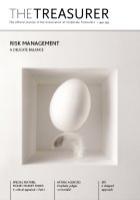
For treasurers, these clouds have a silver lining of sorts in that they represent an opportunity to prove your real worth. The risks in business are considerable at the best of times but companies are now more exposed than at any time in the past 30 years. Equally, the opportunities are there for those companies which are strong (and brave) enough, and, you could say, have the best treasurers. To help you on the way, this month’s Spotlight examines what risks there are and how treasurers can best manage them. And, in the June Spotlight, we examine other ways in which treasurers can provide added value and underline the business case for treasury.

Traditional aspects of treasury still need to be managed in such a way as to provide maximum value. One area which is increasingly used by treasurers to manage their liquidity is money market funds. In a new departure for The Treasurer, in the next three editions we are running a special feature: Money Market Funds – a critical appraisal.

So, whether at the ‘risky’ or the ‘traditional’ end of treasury, I would advise you to take a deep breath, brace yourself and start heading for that light at the end of the tunnel. Just keep an ear open for the sound of an oncoming train.

MIKE HENIGAN
Managing Editor
A rating agency view (TT May03 x-xi)

BEFORE discussing the process of rating a money market fund, we should first agree on the definition of a money market fund (MMF). Globally, money funds can take on a variety of guises; some look like deposits, others like short-term bond funds. In certain markets, such as the US, MMFs are clearly defined by regulation. In Europe, however, the UCITs directive does not define an MMF and the definition of a money fund falls into domestic regulation.

Money market phenomena (TT May03 iv)

MONEY market funds (MMFs) are a relatively new phenomenon in Europe. The funds were developed in the US at the start of the 1970s and first regulated by the Securities and Exchange Commission (SEC) in the US in 1983. However, they didn't make an appearance in Europe until the mid-1980s, when they first appeared in offshore European centres such as Dublin, Luxembourg and the Channel Islands. Since then, however, growth has been stellar. Funds under management within Europe grew from less than $ 1bn in 1995 to more than  $130bn at the end of 2002, according to trade body The Institutional Money Market Funds Association (IMMFA), and that growth shows no sign of slowing.

The treasurer’s view (TT May03 v-iii)

THERE IS, of course, no single view of money market funds (MMFs) among European-based treasurers. There are also typically no long-established European views, because MMFs are still relatively new to the European market. However, according to recent estimates, MMFs are now actively used by roughly half of large European corporate treasury departments and their usage is growing rapidly.

Obstacles to a quick recovery (TT May03 p6-7)

The outlook for the global economy is deteriorating, partly reflecting the impact on business and consumer confidence from higher oil prices over the past year and the ensuing conflict with Iraq. In addition, the consequences from the decline in stockmarkets over the past two years is still having a knock-on effect. As a result, both governments and private economic forecasters have been compelled to gradually revise downwards their forecasts for real GDP growth for this year.

International Bonds (TT May03 p8-9)

These are a selection of bonds announced recently. The details, updated to the middle of last month, were supplied by Thomson Financial Securities Data and other sources.

marketwatch HOTLINE (TT May03 p10-14)

New UK-US treaty
A new double taxation treaty between the UK and the USA came into force on 31 March 2003. The treaty replaces the earlier double taxation agreement which dated from 1975.

Brown's wartime budget (TT May03 p15-16)

The Budget on 9 April was widely reported as the first British budget delivered in wartime since 1945. Presumably the ‘teenage scribblers’ writing this never covered the Korean war at school. While the Budget sounded relatively quiet, there is still much change for treasurers.

Master class in ISDA (TT May03 p17-19)

The ISDA 2002 Master Agreement (the 2002 Master) represents the culmination of a Strategic Documentation Review (SDR) begun by ISDA in late 1999. The aim of SDR was to update the ISDA 1992 Master Agreement (the 1992 Master) to take account of legal developments, changes in risk management practices and practical (as well as, in the case of the Russian debt and Malaysian currency crises and the collapse of Enron, bitter) experiences in the international swap markets. Certainly, all these influences are evident in the 2002 Master.

Appraising financial guarantees (TT May03 p20-22)

The ability – even the intention – of published financial reports to present a true and fair view is under attack more than ever before. As a result, accountants, auditors and their regulators seek every opportunity to report transparently every source of value and risk. While exotic new credit derivatives enjoy the full glare of standard-setting, financial guarantees receive relatively cursory and even contradictory attention, despite their growing significance and close affinity to other credit derivatives, notably credit default swaps (CDS). Fortunately, a mass of multidisciplinary thought is available which, duly co-ordinated and unified, will improve corporate value and stability and lead to truer and fairer corporate reporting.

Show and tell (TT May03 p23-25)

For many treasurers, it seems, a corporate credit rating is much like Forrest Gump’s now proverbial box of chocolates – “you never know what you’re going to get”.It is therefore not surprising that the need for an enhanced information flow on the bases for rating decisions emerged as a recurring leitmotif in a series of roundtables featuring treasurers, investors and market professionals at the ACT conference, Rating Agencies: Prophets, Judges or Mere Mortals?, sponsored by Merrill Lynch.

Online FX – STeP this way (TT May03 p26-27)

Much has been written about eFX and the associated benefits of straight-through processing (STP). While awareness of this trading channel has increased dramatically in the past two years, so has the confusion among readers surrounding what is actually meant by it. The simple answer is that STP means different things to different people. There is, however, general agreement in a high level definition: STP is the automation of certain elements within your trading cycle.

The right approach to funding (TT May03 p28-30)

When it comes to acquisitions, making the right moves is crucial to success. The tip is, says Ian Howey of Fortis Bank, to ensure you don’t cut any corners.

'Risk' and 'life' -- four-letter words (TT May03 p32-33)

Life is a sexually transmitted disease that is always fatal. I don’t know who first uttered this cliche or in what context, but it serves to underline a point about life assurance. If you’re gonna go sometime (and you are), then it is not a question of ‘if’ but ‘when’, and it is against that background that decisionmaking and valuation take on a different perspective. The key to appreciating life is balancing a probability now against a future that may not happen. Risk is a fundamental of existence – a balancing of one thing against another, neither of which may be known.

Business as usual (TT May03 p34-35)

Have the events of the past two years changed the way businesses and treasurers think about risk? The Treasurer asks David Swann, Group Treasurer of BAT.

Causes for concern (TT May03 p36-38)

It seems like a long time has passed since Nick Leeson brought down one of the most established English financial institutions, waking up the entire financial community to the risk of rogue traders. The event triggered in both financial and non-financial institutions a series of very high-profile actions aimed at enhancing the quality of internal controls and the monitoring of market risk.

More recently, and perhaps already forgotten, we can recall the frantic and expensive rush of governments and private enterprise to mitigate the risks of non-Y2K compliant technology. The predicted catastrophic scenarios eventually proved to be unrealistic and the entire matter is now more a subject for academic discussions.

Cutting into the capital (TT May03 p39-42)

In March 1994, the UK government issued tenders for the Channel Tunnel Rail Link (CTRL) project, the UK’s first high-speed railway from the Channel Tunnel to London. London & Continental Railways Limited (LCR) was formed to bid for the project and assembled among its shareholders a set of skills to finance and project manage the construction of the CTRL and manage Eurostar train services.

The hedge tenor dilemma (TT May03 p43-45)

While companies have become increasingly knowledgeable about currency risk management, many still struggle with the problem of strategic hedging. More specifically, multi-year adverse trends remain a key issue, creating undesirable volatility in companies’ performance, as well as decreasing results in their reporting currency.

Gaining the right exposure (TT May03 p46-48)

The recent performance of the UK economy does not meet the classical definition of a recession (two consecutive quarters of negative growth). Also, unlike all other post-war recessions, this was not caused by high interest rates puncturing an asset bubble.

Time to reassess the risks (TT May03 p49-50)

There is currently good reason to be particularly interested in commodity markets. The price of a barrel of oil is striding towards 20-year highs, and has fallen more than 30% since the war in Iraq began: aluminium prices have been poor because of anticipated expansion of Chinese production capacity and coffee and cocoa prices have made huge gains up from lifetime lows caused by global over-production. Alongside these supply-side factors, investors continue to be interested in commodities as an alternative to the traditional investor markets of equities and bonds, particularly with gold and oil returning to the headlines. This article analyses why treasurers are increasingly being made aware of their businesses’ exposure to commodity price movements and why they are turning to the financial markets to mitigate these risks.

Basel II: the new accord (TT May03 p51-53)

We all know it is coming, but how will this simple formula affect the banks’ perception of corporate credit risk and, in turn, how should companies view banks? In this article, we will examine and assess some of the possible impacts the Basel II Accord (the new Accord) will have on the way companies undertake business with banks.We will also look at a number of the proposed changes to credit risk management in the areas of risk weighting, capital adequacy and credit risk mitigation (CRM).

End of an era for ACTICAS (TT May03 p57)

Back in April 1992 ACTICAS, under the Chairmanship of Archie Donaldson, was formally launched, as a joint venture partnership between the ACT and the Institute of Chartered Accountants of Scotland (ICAS). For more than ten years this partnership has managed the provision of the Associate Examination, which is absolutely central to the ACT as the qualification leading to associate membership. ACTICAS is now being dissolved as a partnership and I am delighted to have the opportunity to pay tribute to ICAS and their contribution to the success of the ACT’s educational programme.

Conferment Ceremony 2003 (TT May03 p58-59)

The 2003 Conferment Ceremony took place in the elegant city surroundings of the Stationers’ Hall in London. The event, which was sponsored by The Curzon Partnership, afforded an opportunity to recognise the achievement of all successful MCT, AMCT and Cert ICM students who completed in 2002.

Email this page to a friend
CertICM - Certificate in International Cash Management