
The Treasurer November 2008

The Treasurer November 2008

Treasurers must win the working capital war

As the credit and banking crisis segues into a global recession it may be tempting to indulge in a bout of finger-pointing and blame allocation, but this really isn’t the time. If the corporate and the banking industries aren’t careful, the credit freeze could turn into a working capital freeze.

An unfortunate but inevitable consequence of any economic downturn is that an increasing number of businesses will fail. Many that go under will, in essence, be sound business ideas brought low simply because they have run out of cash. Treasurers in corporates have to ensure that they are driving the cashflow planning to ensure that a working capital squeeze does not turn into a crisis that threatens the company’s very existence.

At such times it is tempting to reach for any tools or methods possible to preserve cash in the business, even if that comes at the expense of suppliers which may not possess the same financial clout. Treasurers should urge their colleagues not to be tempted into such short-term financial irresponsibility. If no other argument wins, in the long run it can’t be good for companies to see their key suppliers forced to shut down. There has to be a better way.

Treasurers need to re-emphasise the tools of cashflow forecasting and planning. They have to work with the business to ensure that working capital and balance sheet management is done well, and that means a great deal more than simply locking away the cheque book.

As well as using their technical skills, treasurers have to ensure that an open dialogue is maintained. They need to talk to their lenders if they see problems ahead, and crucially they also have to talk to others in the working capital chain.

For companies facing financial difficulties it is much better to be open and transparent, and to make commitments and promises they can keep, rather than duck and dive in the hope that the crisis will blow itself out.

If we learned anything over the last few months it is how trust, confidence and reputations can disappear irretrievably overnight. Treasurers must not allow short-term difficulties with working capital to lead to bigger and more intractable problems.
marketwatch NEWS (TT Nov08 p4-6)

Europe’s ‘comply or explain’ corporate governance codes are the best means of combining best practice with the flexibility needed by companies and should be retained, according to the EU’s commissioner for competition and the internal market, Charlie McCreevy.

The Federal Reserve again rode to the rescue of the US financial system last month. The lifeline this time around was an offer to buy debt directly from US companies unable to borrow short-term funds as the banking crisis intensified.

Reacting to criticism of the role of accounting standards in the credit crisis, the International Accounting Standards Board (IASB) and the Financial Accounting Standards Board (FASB) have created a global advisory group.

marketwatch KEY DEALS (TT Nov08 p8)

The Guinness and Smirnoff drinks giant Diageo provided a long-awaited pick-meup for the slumbering corporate debt market, raising $1bn via a five-year dollar-denominated bond. The issue, due January 2014, will be paying a coupon of 7.375% above what Diageo would ordinarily expect to pay in less creditconstrained times.

A new term has entered the mergers and acquisitions lexicon, with the contingent value right (CVR). Never before used in Europe but the brainchild of some smart Parisian bankers, the CVR is being credited with breaking the deadlock to deliver the £12.5bn takeover of the UK's single largest electricity generator British Energy by French group EDF.

The debt markets remained for the most part closed and there was very little action in the M&A or new equity issues markets either. What excited some investors was the prospect of the long-awaited consolidation of the legion of listed independent oil and gas exploration and production companies. Many analysts believe some of the explorers will merge with each other, but so far the indies have fallen to majors.

A global insight (TT Nov08 p9)

JPMorgan Asset Management has just received the results of its annual Global Cash Management Survey 2008. It will be the 10th edition of the survey, which has been providing a benchmark for the identification of ongoing cash management trends among treasurers since its launch in 1999.

marketwatch TECHNICAL UPDATE (TT Nov08 p10-11)

In normal times the policy work of the ACT and its influencing role run on extended timescales. New rules and regulations from the authorities flow from discussion papers, followed by draft proposals, and then the final rules. At each stage, there is at least three months for consultation, with time for processing and feedback. But in today’s markets a week is a long time. Adjusting to this, we have been pleased to be able to feed the corporate viewpoint into the topics of the moment and under review at official levels, or indirectly via the press. Among all the problems within the financial services sector it is important to ensure that the customers which depend on those services are not forgotten.

Finding the responsible course (TT Nov08 p12-13)

How do you work with colleagues and external parties to improve working capital?

The darkest hour is just before dawn (TT Nov08 p14-16)

It is inevitable that the financial sector will have to submit to tighter regulation and possibly a return to a Glass-Steagall type of structure. Sadly, the sector has shown that it cannot be trusted to cope with the conflicts of interest that integration engendered. In addition, banking will become a duller and more staid existence, with innovation discouraged. It may even cease to be a career destination for the brightest young graduates.

Deals of the year awards (TT Nov08 p17-19)

Whatever else you might say about 2008, it will live long in the memory. The financial and banking crisis, bad enough on its own, joined forces with a gathering recession in the real economy to create – to borrow a favourite phrase of the pension industry – the perfect storm.

Ready for anything (TT Nov08 p20-22)

The tremors that have shaken the financial sector in recent months have proved challenging for organisations of all sizes. Even those sectors better protected from an economic downturn are not immune. Fortunately for Stephen Darnley, group treasurer at Regus, his career has included working for several companies during periods when they were undergoing change and facing substantial challenges.

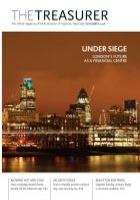
London under siege (TT Nov08 p24-26)

After the financial tsunami of recent weeks, what are the prospects for London’s future as a major financial centre? In the short term, they appear pretty bleak. The UK’s financial sector is set to contract (or “de-leverage”) dramatically, and its earnings and contribution to the economy will also shrink. Indeed, it has become clear that much of the profit the City generated over the past few years has not been genuine.

Starting a new chapter (TT Nov08 p28-29)

When gaining access to all the funding a corporate could possibly need was about as taxing as a stroll in the park, the raison d’être of both treasurers and relationship
bankers was in some doubt. But with financial markets in seizure, the true worth of the relationship between treasurers and their banking partners has been thrown into sharp relief. Treasurers in financial and risk management functions play a critical part in working with bankers to ensure that their corporations, and therefore the wider economy, are able to function.

Lock and key liquidity (TT Nov08 p30-31)

The current credit crisis has altered the risk-return equation in favour of minimising risk at a time when funding options for corporates are increasingly scarce. A two-pronged approach to hedging that optimises the capital structure while allowing the corporate to create real cash benefits from market opportunities should therefore be adopted. The value of this approach has never been as clear as in the current market environment.

Setting a framework (TT Nov08 p32-33)

Bertelsmann is a large media group, mainly operating in Germany, France, England, Spain and the US. In 2007, it reported annual revenues of €18,578m and EBITDA (earnings before interest, taxes, depreciation and amortisation) of €2,467m. The treasury team sits within Bertelsmann’s corporate treasury and finance operation, alongside corporate finance, international finance and insurance. The organisation has a system of treasury review that assesses treasury reports and is responsible for the risk assessment of treasury issues, such as the calculation of value of risk and interest rates. The treasury team reports directly to the head of treasury and finance. The treasury also has a separate back office that deals with daily administration issues.

Security issues (TT Nov08 p34-35)

The ability of corporate treasurers to add value in pension transactions is increasingly clear. One area where they should be involved, given their credit and security expertise, is when a pension scheme is considering a buy-out or a buy-in.

Finding time to reflect (TT Nov08 p36-37)

There is no doubt that with increased pressures on time and resources there also comes a need for treasurers occasionally to step back, pause and reflect on key strategic business and management issues. talkingtreasury offers the opportunity for different organisations to share their approach and experiences in treasury and to generate some lively debate both in the working sessions and during the networking breaks. This year’s conference in Stockholm was no different, but meeting at a time of crisis in markets made it all particularly useful.

Pay phones (TT Nov08 p38-39)

The mobile phone is ubiquitous. The GSM Association, a global trade group representing 700 GSM mobile phone operators, says there are more than three billion mobile phones active worldwide, and there are now more of them in developing economies than developed. A recent white paper from Juniper Research summed up the potential of the phone as a payment device: “User demand for convenient and intelligent ways in which to make payments for goods and services using a mobile phone is creating exciting opportunities for those organisations that are part of the payment ecosystem.”

A change in focus (TT Nov08 p40-41)

Provisions of the Companies Act 2006, which came into effect on 1 October this year, may provide opportunities for companies to achieve greater market share via trade acquisitions at the same time as reducing transaction costs. But directors of target companies will now need to be more mindful of the common law duties they owe to their companies in such transactions.

Blowing hot and cold (TT Nov08 p42-44)

Even if the desperate remedies taken by governments to get banks lending again prove effective, sovereign wealth funds are already major players in the financial markets and their importance is set to increase over the coming years.

Sovereign wealth funds – the name given to government-owned capital funds – can trace their origin back some 50 years, but their regular appearance in the media’s business pages is a fairly recent phenomenon. Alongside them stand government-owned investment companies, such as Abu Dhabi’s Mubadala Development Company, which have some different characteristics from sovereign wealth funds and sovereign pension funds.

Uncertain times (TTNov08 p45)

The past two months have been unprecedented, both in the magnitude of changes occurring and the speed with which they have occurred. As a result, assessing the impact of those changes on the treasury recruitment market and the effect they will have over the next six to 12 months is, to some degree, speculative and subject to events.

Keywords associated with this page

From the Treasury Services Directory