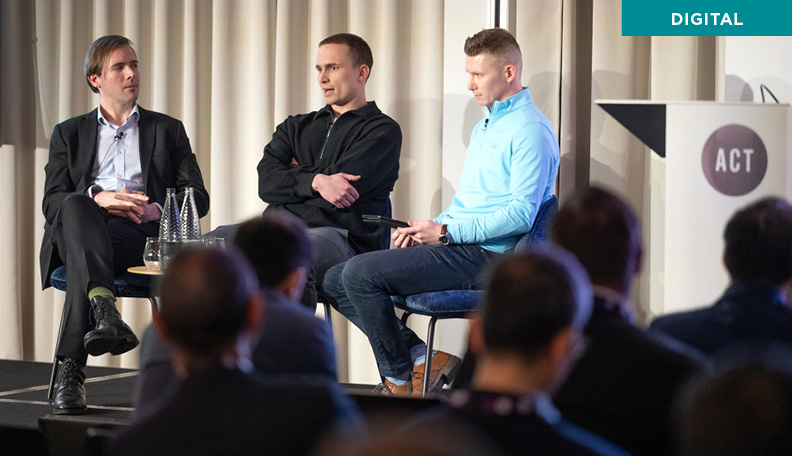
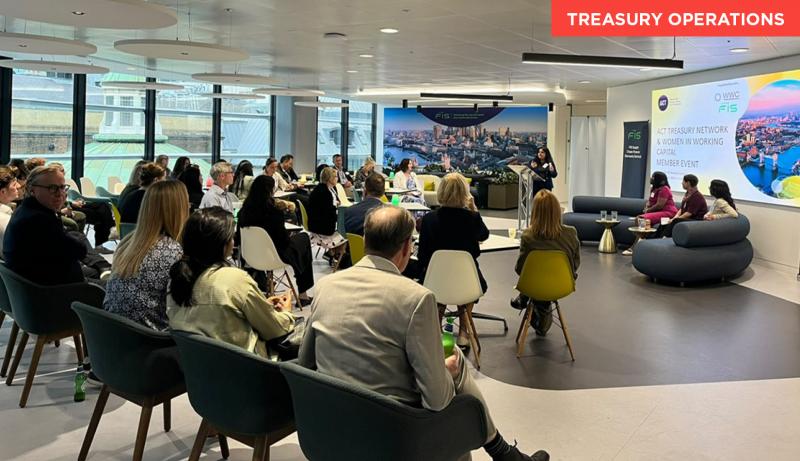
On Thursday 10 September approximately 50 people, a mix of Association of Corporate Treasurers (ACT) members and members of the Women in Working Capital network, were hosted by Fidelity National Information Services, Inc. (FIS) for an evening of conversation and networking.
Ably moderated by Shikha Kalra from FIS, the panel, which comprised Kemi Bolarin FCT, head of treasury at GXO Logistics, Sophia Karanicholas, director at Deloitte Value Creation Services, and Carol Thurnheer FCT, senior manager/regional treasurer at Haleon, brought diverse perspectives to a wide-ranging discussion of working capital.
The session covered topics from the very strategic: who actually owns working capital and where is the greatest value obtained from a working capital transformation programme, to more operational such as lessons learned from various initiatives that the panel had been involved with, and the role of working capital finance solutions.
It was an enjoyable and lively debate. For those who keep thinking about working capital and then pushing it back down the agenda, there were several key takeaways.
The consensus was clear that this needs ultimately to be the CFO or a similar board-level individual. There needs to be clarity and buy-in across the organisation, with culture and drive coming from the top. This has become particularly relevant in an age of uncertainty – geopolitical, funding costs, supply chains – as working capital remains within the sphere of influence of the CFO as a way of improving cash flow and liquidity without necessarily triggering additional funding requirements.
Beneath the CFO, working capital might be managed, depending on the stage in the life-cycle, either as a transformative project or more hands-off, with treasury taking on an air traffic control type of role in an ongoing approach, making sure everything is running smoothly while not explicitly owning any one element of the programme.
In any scenario, collaboration across the business is key. Everyone needs to understand the importance of managing working capital efficiently, be clear about their role in the wider picture and have the tools and data that they need to deliver against their working-capital-related KPIs. And on the subject of KPIs, the selection is also key – we all know that what you measure you get, so organisations need to ensure that they are clear about what they are trying to achieve. For example, a cost KPI in procurement might result in unintended consequences: inventory levels being higher than necessary because procurement got a discount for a larger order.
As with hedging, good practice is to solve what you can internally, before incurring cost and adding complexity with external financing programmes. Do not assume that there is widespread understanding in the organisation of what working capital actually means (payables, receivables, inventory), why it is important to manage, and the levers that can, or should, be pulled to improve working capital.
For example, there was a brief conversation about the payment terms and regulators’ plans to impose strict payment terms. These might have a material effect on both payables and receivables, and the relevant parts of the organisation will need to work together to minimise any overall impact.
Only once you have optimised working capital through pulling the internal levers, and resolving any challenges – and here data quality, and specifically forecast accuracy came up, should the organisation consider external financing solutions. There may be good reasons to implement financing solutions by geography, rather than business units or globally – but it’s definitely not a ‘one size fits all’ solution.
Currently, no conversation is complete without the mention of AI, and this evening was no exception. The panel were all big proponents of the use of technology and reference was made to machine learning, particularly to improve data accuracy. That said, some were somewhat reluctant to use the term AI, asking: ‘what even is AI?’ However described, technology has the potential to be a valuable tool in addressing the challenges around working capital.
We are no longer in an era of near-zero interest rates. Efficient use of financial resources has moved back up the agenda at the highest level of the organisation. Effective working capital management directly impacts treasury and, as such, treasurers would be well advised to make sure they are embedded in working capital projects.
Find out about our next event here.
Sarah Boyce is associate director, policy and technical, ACT