Stablecoins are rapidly shifting from a niche digital asset to a practical treasury tool, offering new ways for corporates to manage liquidity, working capital and payments, according to a recent discussion between treasury practitioners and stablecoin specialists at the ACT’s Tomorrow’s Treasury conference.
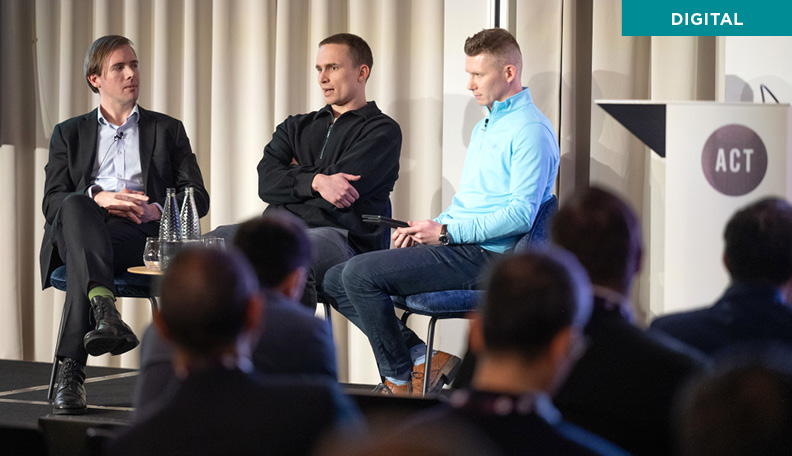
For corporate treasurers, the attraction starts with payments. As Tom Rhodes (pictured above, centre), chief legal officer of UK stablecoin startup Agant, explained, traditional bank transfers are constrained by domestic payment systems, layered infrastructure and settlement delays. “Stablecoins operate on global blockchain networks rather than payment systems,” he said.
Unlike bank payments, which rely on messaging between institutions and settlement in central bank money, “a stablecoin goes peer to peer… and they can be anywhere in the world”. This reduction in infrastructure enables faster, always-on cross-border payments, he added.
Andrew MacKenzie, Agant’s co-founder (above, right), framed the opportunity in broader structural terms. Drawing on his experience of moving funds internationally in both digital assets and traditional finance, he noted the sharp contrast. “When you’ve been using stablecoins to transfer value across the world and then all of a sudden you’re on to legacy systems, you realise the efficiencies,” he said. Those efficiencies underpin Agant’s long-term vision: “We do believe that everything will end up in a tokenized format over the coming decade.”
For treasurers, that vision becomes tangible through working capital management. Dominic Lynch (above, left), co-founder of Your Treasury, highlighted how stablecoins can transform urgent liquidity scenarios. Describing a subsidiary facing a sudden cash shortfall, he said: “With stablecoins… it’s going to happen instantaneously… in a few seconds’ time in order for you to carry out your obligations.” That immediacy reduces reliance on cash buffers built to compensate for forecasting inaccuracies. “That’s a huge amount of stress and time saved,” Lynch added.
Beyond speed, stablecoins also open new approaches to liquidity optimisation. “I can get money around the world very quickly for different types of receivables and payables,” Lynch said, pointing to the direct benefits for working capital. Rhodes expanded on this by explaining how stablecoins can act as a bridge between cash and yield-bearing instruments, allowing treasurers to “instantly swap” between a stablecoin and money market fund exposure without moving cash through traditional rails.
Crucially, credibility and compliance remain central to adoption. MacKenzie stressed that, in Agant’s model, a stablecoin is “a digital representation of a fiat currency that’s backed one-to-one at all times.” Rhodes reinforced the point, arguing that stablecoins are often misunderstood: “The business model itself is extremely safe as a concept,” with backing held in high-quality liquid assets.
Yet the panellists were clear that adoption will be evolutionary, not instant. “We’re in a transition phase at the moment,” Lynch said, noting that stablecoins may only be held briefly before conversion into traditional currencies when counterparties do not yet accept them. Education is therefore critical. “With any new technology… it’s always a huge cultural change,” Lynch observed, emphasising the need to bring CFOs and the wider business along.
Looking ahead, resilience and security could prove decisive. MacKenzie argued that blockchain’s decentralised architecture offers “always-on functionality,” mitigating risks associated with single points of failure. “That level of resilience and the security that that represents… isn’t recognised to the fullest extent,” he said.
Philip Smith is editor of The Treasurer