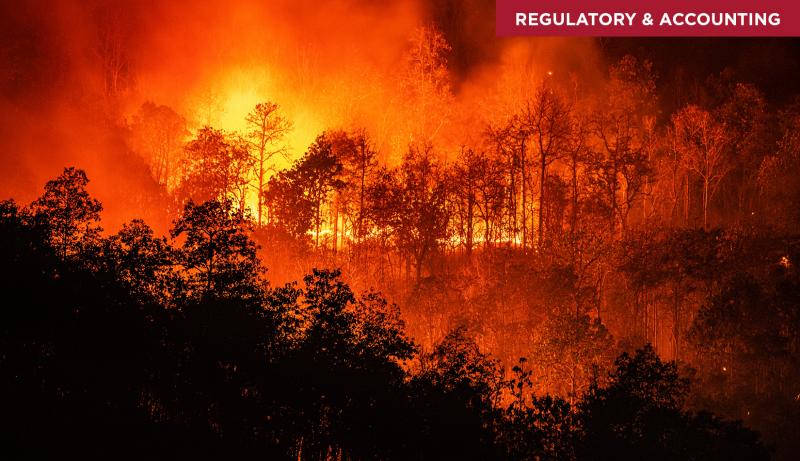
In the summer of 2026, temperatures have broken records on continental Europe, the UK and North America. These areas have also experienced prolonged periods without rain. As a result, there have been extensive wildfires in some of these countries and water levels have fallen to record levels. Furthermore, unexpected heavy snowfall and rain in the Andes in July 2026 has severely impacted local businesses, communities and economies, particularly in mining.
All these extreme weather events are disrupting supply chains across industries, reducing production volumes, particularly food production, and are having a knock-on effect on supply chain reliability, as well as increasing costs for many companies and industries.
So, how can corporate management, their investors, lenders and other stakeholders understand a company’s exposure and risks to climate change and its dependence on nature and the environment?
IFRS S1 is focused on sustainability reporting, whereas IFRS S2, adapted from the TCFD reporting framework, is focused on a company’s climate change
It is for this reason that the Task Force on Climate-related Financial Disclosures (TCFD) and the Taskforce on Nature-related Financial Disclosures (TNFD) risk management and reporting frameworks were developed. The International Financial Standards Board (IFSB), the EU and other corporate reporting standard setters and regulatory bodies around the world have adapted these frameworks, and developed and implemented Sustainability Reporting Standards (SRS).
In 2023, the International Sustainability Standards Board (ISSB) issued two sustainability reporting standards: International Financial Reporting Standards (IFRS) S1 and IFRS S2, effective for annual reporting periods beginning on or after 1 January 2024. IFRS S1 is focused on sustainability reporting, whereas IFRS S2, adapted from the TCFD reporting framework, is focused on a company’s climate change (physical and transition) risks and opportunities.
As of April 2026, 28 jurisdictions had adopted these standards, or modified them to meet local requirements, and another 12 were planning to do so. The EU has its own sustainability reporting standards, the Corporate Sustainability Reporting Directive (CSRD) and action directive, the Corporate Sustainability Due Diligence Directive (CSDDD). As a result, those corporates that are subject to multiple SRS reporting regimes must manage the associated interoperability issues of each.
It is expected that the UK government will require the 500+ listed UK companies to report under UK SRS 2 for the financial year starting 1 January 2027
Currently, UK listed companies must report under the TCFD reporting framework. Early in 2026, the UK’s Department for Business and Trade published the final version of the UK’s own SRS, based on IFRS S1 and S2, but modified to meet UK requirements. It is expected that the UK government will require the 500+ listed UK companies to report under UK SRS 2 for the financial year starting 1 January 2027.
Later in 2026, it is anticipated that the government will start a consultation process to extend UK SRS to large unlisted entities.
The IFRS S1 and S2, and by extension the UK’s SRSs, are aimed at closing the information gap for investors of corporates’ climate and environmental risks, and the associated financial risks that financial statements leave unreported. However, the data and information reported under these standards also help company management, their boards, lenders and other stakeholders understand the potential future financial impacts of climate and environmental risks on the company and their industry.
From a corporate treasurer’s perspective, the physical and transition risk data from these sustainability reports are used by their lenders to assess their company’s credit risk, and by their banks for their own climate disclosure obligations. Furthermore, these reports provide corporate management and their boards with greater insight into the potential financial risks and opportunities from climate change, which can then be used for strategic planning and capital allocation decisions.
The climate and nature risks to which companies are exposed are financially material, yet unreported in their financial statements, as they crystallise over timeframes and through channels that standard financial statements do not include. The various SRSs are an attempt to provide decision-useful, comparable and assured information for a company’s key stakeholders.
Carel van Randwyck, FCA, FCT is a private company CFO, ACT Council member, NED and board adviser specialising in governance, operational transformation, corporate treasury and sustainable finance