Islamic finance has been on a journey in recent decades, from being perceived as a niche product to a respected funding alternative, especially for corporate treasurers.
In the Gulf states, Islamic banking is anything but niche – it accounts for 85% of all financing in Saudi Arabia, 50% in Bahrain and Kuwait and up to 30% in the UAE and Qatar.
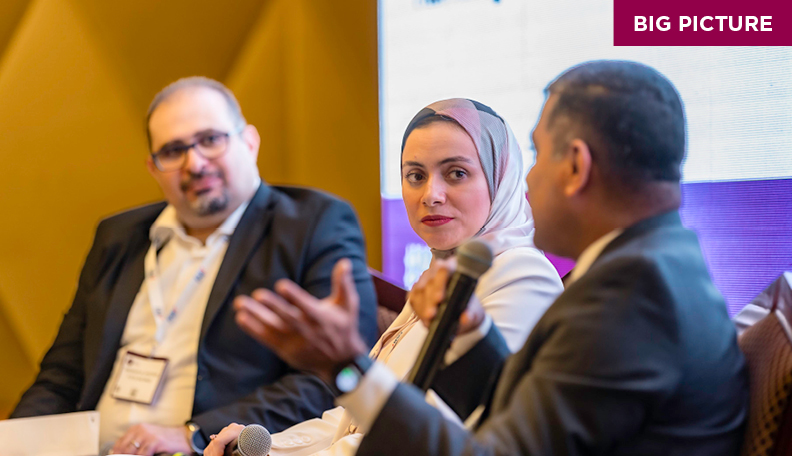
Those figures came from Bashar Al-Natoor, managing director and global head of Islamic finance at Fitch Ratings. He chaired an Islamic Finance session at the Association of Corporate Treasurers’ Middle East Treasury Summit in Dubai, with panellists Norhan Ezzat, head of transaction banking at Bank of Sharjah, and Sanoop Unni, head of balance sheet and asset management at Ajman Bank.
The biggest challenge that I find in treasury is the width and the breadth of the market counterparties that we can deal in a conventional bank, versus an Islamic bank
Ezzat frames Islamic funding as an option among many: “If I'm a treasurer, I need to have a toolkit of products at my disposal from various banking partners and financial service providers to meet my commercial objectives. Islamic financing solutions are just an alternative to those banking structures.”
Unni comes from a conventional banking background and, although positive about some elements of Islamic banking, he also sees problems: “The biggest challenge that I find in treasury is the width and the breadth of the market counterparties that we can deal in a conventional bank, versus an Islamic bank.” This extends to hedging and derivative tools and other instruments, he adds: “Some of the instruments – let's say like a CD – are not well-developed on the Islamic side of things.”
In his experience, that narrower range of options puts constraints on the size and diversity of the liquidity pool available. “The past seven, eight months of crisis have actually exposed some of these things in a bigger manner,” he adds, as Islamic banks’ funding is predominantly local, so a regional crisis hits them harder.
Ezzat points to two key areas where Islamic banking practices offer distinct advantages over conventional ones, especially in financing trade deals.
Some Islamic financing structures require that the ownership of goods – such as inventory held in a warehouse – or properties are actually transferred to the bank for the duration of a deal. Unlike in conventional funding, they are not simply collateral or secured goods.
That means, she says, that companies can potentially take assets such as inventory off their books during warehouse financing, because the bank is the owner.
Similarly, when there is an exchange of receivables against commodities in receivables financing, it involves a stronger true sale of receivables and offers a form of hedge against any FX fluctuations at settlement.
Unni shares Ezzat’s enthusiasm for Islamic structures in trade financing, because the underlying transaction involves buying or selling of goods. When pricing is the same, the Islamic option “should give you more comfort”. The key, he says, is not to compare Islamic and conventional banking only on price, understanding the nuances of the documentation is important.
In areas outside trade, though, he is more cautious. For example, Unni explains how the Basel III bank regulations were developed for conventional banking but that they stop short of recognising different treatment for Islamic banking. Sukuk may have lower loss given default risk, but capital rules give them the same risk weight as an unsecured bond. If regulators were to recognise the differences, he foresees Islamic instruments becoming more attractive to international investors.
So why in banking does the Islamic product have to look different from the conventional counterparts?
Ezzat has a very clear view of what’s needed to make Islamic finance more open and appealing: “When you go to a McDonald's here, it's a burger, but it's halal. When you eat it elsewhere, it's not, but it looks, tastes and feels the same. So why in banking does the Islamic product have to look different from the conventional counterparts?”
She says it’s up to banks to make Islamic banking simpler and more attractive. Jargon needs simplifying and products should be an appropriate financing alternative, much as sustainable banking occupies a specific sector in the industry.
In contrast, Unni says he has a 10-page list of improvements. But restricting it to his treasury background, he highlights derivatives: “I don't have a really good derivative instrument that can help me in balance sheet management, which a conventional bank has.”
Also, he sees problems in the interbank money market: under a wakala placement, Sharia rules require the borrowing bank to undertake that the funds are used for Islamic purposes only: “If you now tell a money market trader that out of his $300 billion of daily liquidity, $10 million is only being used for Islamic purposes, it’s very tricky and no conventional bank will tell me that.”
The conclusion seems to be that, while significant pools of Islamic funding are available, clarity, explanations and a review of banking regulations are needed to bring it further into the mainstream.
Nick Walshe is a journalist based in Dubai