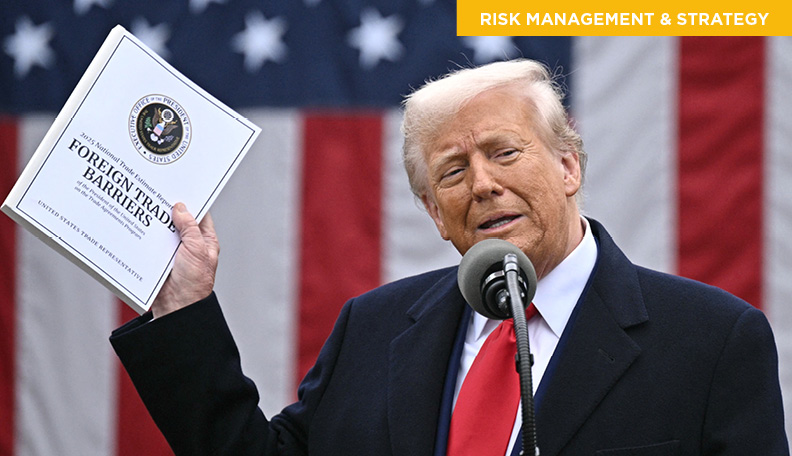
The global business environment has taken a hit over the last year. From currency shocks to trade disruptions, the FX landscape is becoming ever harder to predict. Reignited levels of volatility in major world currencies spell trouble for businesses, particularly those operating internationally. Few would have foreseen that the US dollar would hit a three-year low just six months into Trump’s presidency, especially given it was at a two-year high around the time he took office.
For years, currency risk has been treated as a background issue, something for treasury teams to quietly manage while the rest of the business focuses on flashier priorities. However, tariffs and dollar volatility are suddenly pulling currency risk into sharp focus for global businesses. Corporates are now realising that they can no longer afford to be passive and are taking action to evolve their FX hedging strategies and minimise losses to their bottom lines.
Tariffs have become one of the biggest economic flashpoints of 2025, dominating headlines and driving volatility across global markets. Liberation Day, for example, saw the Trump administration escalate its tariff-driven foreign policy, which sent the S&P plunging nearly 10% over only two days. Tariffs have also caused huge FX market instability, with the dollar witnessing its worst half-year compared to major currencies since the 1970s, significantly upping the risk for businesses with international supply chains.
Among North American corporates, tariff-driven currency volatility has taken a toll on nearly seven in 10 (69%), eroding profitability and undermining competitiveness in international markets. Similarly, more than half (56%) of UK corporates said that tariff-driven dollar weakness has negatively impacted their businesses’ finances in 2025, and 62% of UK and US corporates have experienced losses from market volatility so far this year.
Unhedged FX risk has compounded the problem, with more than four in five US firms (83%) reporting losses. In stark contrast, just one in five (20%) said currency movements had benefited their business.
The FX volatility brought on by tariffs, particularly within currencies like the dollar and euro, has exposed just how vulnerable even the most stable-seeming firms can be to FX risk. For US businesses exporting internationally, a weaker dollar can boost competitiveness, but for importers, it’s raising costs at a time when shifting global trade dynamics are already clouding their outlook. Similarly, businesses exporting to the US, from the UK or Europe, for example, are now at a disadvantage, whereas those importing now hold more buying power. Fortunately, corporates are taking action.
With currency volatility surging to levels not seen since the Silicon Valley Bank and Credit Suisse collapse, corporates are implementing new hedging strategies to protect their bottom lines.
More than nine in 10 (91%) North American firms now hedge their FX risk; a sharp increase from 82% in 2024 and 81% in 2023. Additionally, of the firms that don’t currently hedge their FX risk, more are now considering doing so in 2025 (65%); another significant increase from last year’s 51%.
Not only are firms hedging more, but they’re shifting their hedging strategies altogether. Extending hedge lengths was also the top priority for UK businesses (56%) in the wake of US tariffs, with lengths increasing to as high as 6.74 months this year. Similarly, the most popular change to North American hedging strategies in 2025 was increasing hedge lengths (64%).
Extending hedge lengths is a defensive strategy that allows firms to lock in rates for longer, providing greater certainty and stability amid ongoing volatility. As more market participants look to buy near-term protection, market spreads on short-end instruments are increasing. Hedging further along the curve maintains the same level of protection against currency movements, but without the need to crystallise profit and loss generated by short-term FX swings.
Hedge ratios in the UK and US have also been on the rise, now sitting at an average of 57%, up from 47% a year before. Elevated hedge ratios in 2025 are a sign that corporates are moving to protect greater amounts of FX risk as the market experiences new levels of volatility at the hands of tariffs and broader geopolitical instability. The more risk they leave exposed, the greater the chance of incurring losses on unhedged capital.
In North America, automation was firms’ second-highest priority (32%), reflecting a push to streamline operations, reduce manual errors and increase responsiveness. As the FX market becomes increasingly complex and uncertain, the ability to act quickly and accurately through automation can give firms a competitive edge.
All North American businesses surveyed outsourced some part of their FX operations. Outsourcing offers significant benefits, such as improved transparency in execution quality through transaction cost analysis and comprehensive management of FX operational tasks. By entrusting these complex functions to specialised providers, businesses can streamline their operations and concentrate on their core competencies, driving growth and innovation.
This renewed focus reflects a broader recognition that outsourcing and automation can offer access to better pricing and top-tier counterparties, benefits that are often out of reach for smaller or mid-sized corporates.
Trade wars, diverging central bank policies and macroeconomic uncertainty are injecting renewed unpredictability into the market. And while volatility hasn’t yet reached the extremes seen in the early 2020s, the signs are there with sharper price swings.
For CFOs and treasurers, this means it’s time to reassess FX risk management from the ground up. This includes not only refining hedging strategies and selecting the optimal mix of instruments, but also leveraging technology more effectively. Automation and outsourcing are increasingly central to this effort, improving speed, accuracy, and decision-making at every stage, from exposure tracking to trade execution.
In an era where currency swings can erase quarterly gains, proactive FX risk management is no longer optional; it’s essential. The companies that emerge stronger from this period will be those that treat volatility not as a threat, but as a test of strategy, agility, and leadership.
Tom Hoyle is head of corporate solutions at MillTech
This article also examines the data and results of surveys by Censuswide on MillTech’s behalf conducted in during 2025 based on surveys of 250 CFOs, treasurers and senior finance decision-makers in mid-sized corporates (described as those who have a market cap of $50m up to $1bn), in the US and UK.