
ESG update July 2026
This blog is part of a quarterly series on the wide topic of Environmental, Social and Governance and covers items that have caught my attention.
Official announcements
• The UK Government announced plans to introduce new regulations requiring businesses to ensure that their supply chains are not contributing to illegal deforestation, including new mandatory due diligence requirements, with a consultation on the new rules to be launched this year.
The government said that its approach will propose covering the same core commodities and underlying information requirements to be used in the EU’s Deforestation Regulation (EUDR), in order to help businesses avoid administrative duplication and to enable consistent data and traceability standards for companies.
Under the new proposals, companies that trade in commodities sourced from rainforests such as soy, palm oil, cocoa and rubber will need to check that their supply chains are not contributing to illegal deforestation.
• Europe’s three primary financial regulatory agencies - European Securities and Markets Authority (ESMA), European Banking Authority (EBA), and European Insurance and Occupational Pensions Authority (EIOPA) each announced the release of a series of proposals aimed at simplifying disclosure requirements and reducing the reporting burden for companies, asset managers, banks and insurers under the EU Taxonomy regulation with the consultations open until 12 August 2026.
Resources, Reports and Announcements
• Lloyds Banking Group and regenerative agriculture company Wildfarmed announced the launch of the new Food & Nature Resilience Fund, designed to accelerate the transition farmland in the UK to regenerative agriculture by supporting the adoption by farmers of practices that improve biodiversity, soil health, water quality and reduce carbon.
• According to KPMG’s Closing the Sustainability Valuation Gap, although a significant majority of companies have a strong understanding of their companies’ sustainability strategies, fewer than one in five companies currently use robust methodologies to quantify the financial impact of sustainability on value creation and future performance.
Only 19% of respondents reported that their companies apply commonly-used financial valuation approaches, such as digital twins and Monte Carlo simulations, to measure the impact of sustainability on value creation, for factors such as financial outcomes, operational gains and innovation. This was felt due to a lack of tools capable of connecting sustainability with financial performance, with frameworks and value drivers not yet in place, and that “quantification techniques, where they exist, are often fragmented and inconsistent.”
• Private equity and venture capital investor EQT Group announced that it has established a new $4.4 billion sustainability-linked loan, with interest rates tied to the performance of portfolio companies in its Asia Pacific-focused private equity fund, BPEA IX, towards material company-specific sustainability targets.
• The International Organisation for Standardisation released its draft ISO Net Zero Aligned Organisations Standard (ISO 14060), its first global standard designed to support companies in developing credible and comprehensive net zero transition plans.
The new standard sets out principles and requirements for companies and other organisations to develop, implement and communicate a net zero aligned pathway, including setting emissions reduction targets, developing plans, taking actions and monitoring and reporting verifiable progress towards the net zero goals.
• Amazon has expanded its carbon credit service to the UK, aimed at enabling companies in its value chain to access high-quality carbon neutralisation and inset credits. According to Amazon, the service helps to address key challenges facing companies in accessing carbon credits to address residual emissions and meet their climate goals, including assessing and vetting quality credits, with only about 5% of neutralisation credits in the voluntary carbon market meeting Amazon’s quality criteria, and overcoming contracting complexity.
The service is available to Amazon suppliers, enterprise customers, and Climate Pledge signatories, with requirements for participation including having a net zero target for no later than 2050, covering Scope 1, 2, and 3 emissions and measuring and reporting greenhouse gas emissions on a regular basis.
Credit types available under the program include those generated through super-pollutant abatement, including refrigerant destruction and rice methane abatement, programmes focused on reducing deforestation and restoring forests, and technological carbon removal such as Direct Air Capture (DAC), as well as carbon inset credits from the production of lower carbon fuels.
The program forms part of Amazon’s Sustainability Exchange resource hub, launched in 2024 as a platform to offer companies – particularly those in Amazon’s supply chain – with free access to sustainability tools and resources used by Amazon to decarbonise its operations, to help them to address their own climate footprints.
• SBTi released Corporate Net-Zero Standard Version 2.0. Among the key changes introduced with the new standard is the use of a “best-efforts” framework, enabling companies to remain in compliance with the standard even if targets are not achieved, with an expectation for companies to utilise “all available levers to drive emissions reductions,” and to be transparent about implementation barriers and mitigating actions, with the SBTi “acknowledging that factors outside a company’s control may affect progress.”
• The Taskforce on Inequality and Social-related Financial Disclosures (TISFD) released the first draft version of its framework, designed to enable companies to understand and report on their businesses’ impacts dependencies, risks and opportunities related to people, encompassing issues such as human rights and inequality.
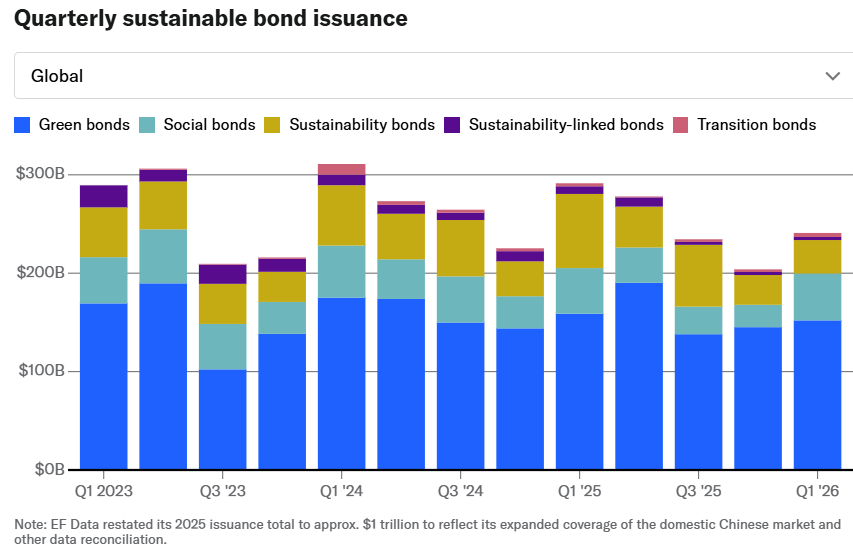
• According to Moody’s the global issuance of labelled sustainable bonds – including green, social, sustainability, sustainability-linked, and transition bonds – rebounded sharply in the first quarter of 2026 compared to the prior quarter, led by strong growth by European issuers and a jump in social bond issuance, but remained below prior year levels.
Naresh Aggarwal
14 July 2026