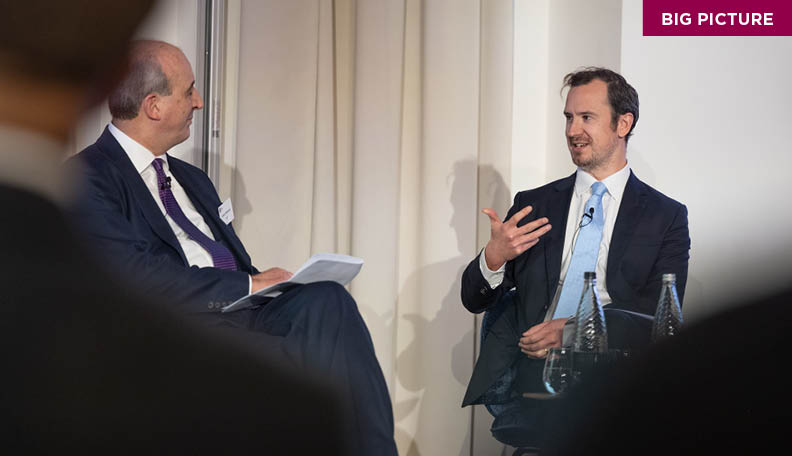
Speaking shortly after the UK Autumn Budget, Dave Eaton, head of financial services policy at H/Advisors Cicero, told attendees at the ACT’s Tomorrow’s Treasury conference that, while the Chancellor avoided major shocks for business, the measures announced will not materially shift the UK’s growth trajectory.
“None of the measures announced [in the Budget] are going to have a material impact… none of them are material enough to actually change GDP,” he said, responding to interview questions. He added that, although the corporate tax roadmap had largely been respected, sparing firms from repeats of last year’s surprise National Insurance rise, the Budget had not removed uncertainty for business investment. “I think it is marginal, but ultimately there is less certainty,” he said.
Eaton’s analysis was reflected in the sentiment expressed by attendees at the conference. In a poll, attendees were evenly split between those who were more pessimistic about the prospects for their business (44%) and those who felt their prospects were about the same (47%) after the Budget. Only 7% were more optimistic.
Eaton warned that, despite government rhetoric on growth, only a handful of measures provide meaningful medium-term planning stability for businesses. He pointed to the introduction of HMRC’s tax certainty service and progress on infrastructure planning reform as marginal positives, though insufficient to shift investment decisions at scale.
Meanwhile, changes to capital allowances will complicate treasurers’ investment pipelines. Eaton advised companies to review how the new writing-down rates, shifting to a 40% first-year allowance and a fall from 18% to 14% thereafter, will affect major projects. “Have a look at your investment pipeline and how changes in write-down rates might affect that,” he advised.
That's going to affect real household disposable income...
For corporate treasurers in consumer-facing sectors, Eaton highlighted a major looming headwind: the freeze in income tax thresholds. This will pull 1.7m more people into higher-rate bands, according to the Office for Budget Responsibility (OBR), pressure that Eaton said will have real-economy consequences: “That's going to affect real household disposable income; it’s going to be down by about a quarter of a percentage point on average year on year between now and 2030.”
He added that salary-sacrifice reforms, due in 2029, will impose additional burdens for employers offering pension flexibility. Though distant, the changes may alter workforce costs and compel companies to consider lobbying: “If you decide that, actually, your exposure is particularly high, you may want to think about representations between now and 2029.”
When asked what treasurers should prioritise before year end, Eaton offered a concise checklist: reassess capital projects under the new allowances; model exposure to declining consumer demand; and understand how future salary-sacrifice changes may alter compensation structures. Treasurers should also be alert to geopolitical and market volatility, including risks of an AI-driven equity correction modelled by the OBR.
This Budget does not give us confidence that the government has a cohesive strategy to deliver growth
In her official Budget response, ACT chief executive Annette Spencer also stressed that the measures fall short of what corporate finance leaders need. She noted that, while avoiding new corporate tax rises is welcome, “this Budget does not give us confidence that the government has a cohesive strategy to deliver growth”.
She warned that lower household spending power and reduced investment incentives risk undermining productivity, concluding: “Corporate treasurers can help deliver the UK’s growth mission, but only if government policy gives them clarity, stability and the confidence to invest.”
Philip Smith is editor of The Treasurer