
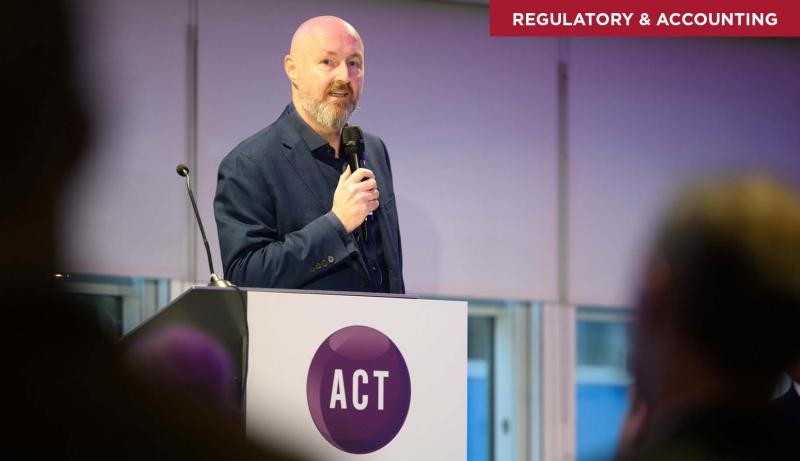
The adoption of tokenisation is accelerating (see box below), with some institutions already introducing these into day-to-day operations. However, while it is gradually moving into the mainstream, regulatory clarity and interoperability are necessary to ensure tokenised markets integrate safely and efficiently with traditional financial systems.
Mark Williamson (above) is chief commercial officer of fintech company ClearToken, which provides financial market infrastructure for digital assets. At a keynote presentation at the 2026 ACT Cash Management Conference, he framed the development of tokenisation over the coming decade and the implications for treasury. He outlined how regulatory frameworks for digital asset infrastructure are increasingly being put in place across the globe to enable secure tokenisation.
“While traditional assets and payments of cash and assets currently far outweigh digital assets we are at the very, very early stages of this,” Williamson said. Out of an estimated $800tn worth of assets currently in the market only $36bn has been tokenised so far, but he highlighted forecasts suggesting this will rise to $100bn by the end of 2026, $2tn by 2030, and Standard Chartered’s bullish $30.1tn prediction.
“There is real momentum around this,” Williamson said. “The opportunity is there – we’re seeing it moving from the lab room to the board room.”
He also focused on the opportunities for treasury. These include:
Nonetheless, interoperability across chains, custodians, central counterparties and CBDCs was a vital factor for the success of tokenisation, Williamson said, with central clearing and settlement essential for new entrants and growth.
For the average treasurer, exploring tokenisation in financial services is probably not yet high on their urgent ‘to do’ list. But with forecasts such as a 2024 report by Standard Chartered and Synpulse predicting that by 2034 the demand for tokenised real-world assets could reach more than $30tn (compared with today’s estimated $36bn of tokenised assets), transformation of traditional financial assets into digital tokens over the next decade is clearly a development that corporate treasurers should be switching on to.
Tokenisation is a process that lets you digitally represent asset ownership for tangible or intangible assets as digital tokens using distributed ledger technology such as blockchain. This includes financial assets such as stocks, bonds, bank deposits, cash or cryptocurrency and physical assets such as real estate.
Using blockchain technology, these tokens are programmable, traceable and transferable, allowing for the ‘fractionalisation’ of assets. Once the asset is represented as a token, it can be speedily and cost-effectively traded or transferred, or used as collateral.
The key benefits of tokenisation include reducing costs and increasing speed of transfers and transactions, boosting operational agility, flexibility and transparency. This enables improved capital efficiency and risk management, as well as opening access for people to capital markets that were previously reserved for institutions. Tokenisation also promises faster, 24/7 financial settlement and reduced reliance on intermediaries, which, for treasurers, means a 24/7, always-on real-time liquidity environment.
Phil Lattimore is a business journalist