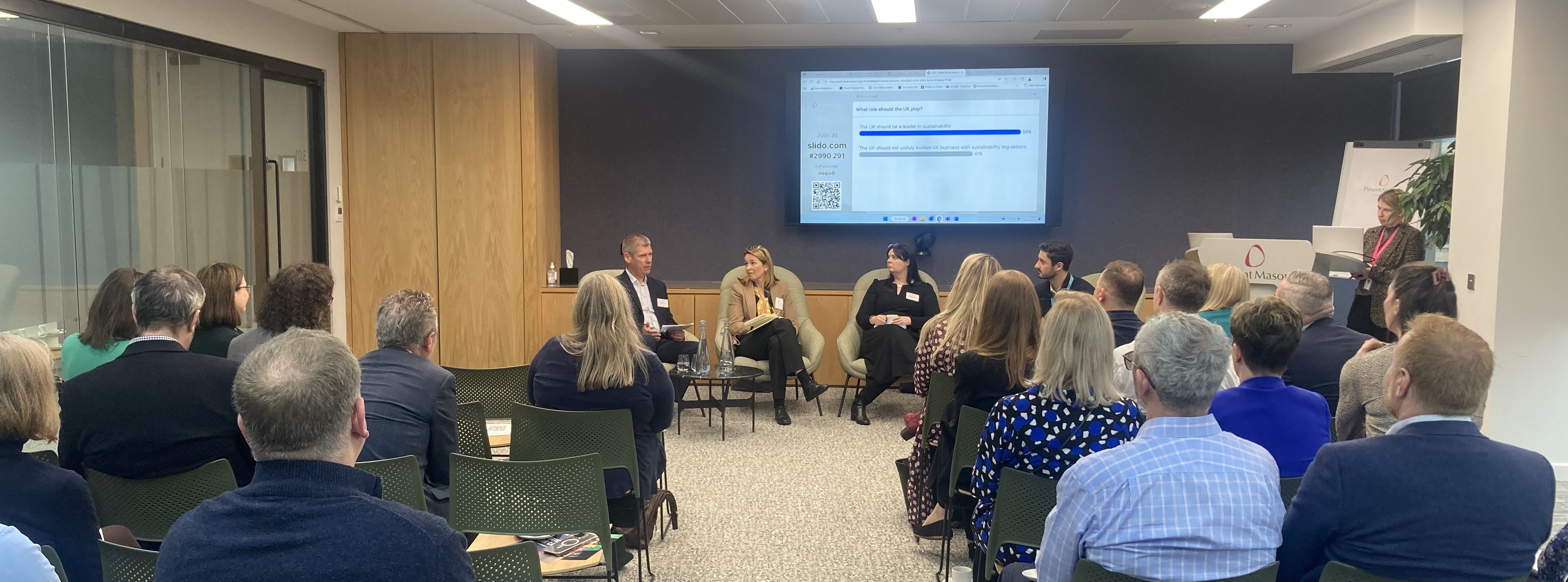
We recently brought members together in Edinburgh for an expert panel discussion on where we currently stand with ESG, kindly hosted by Pinsent Masons at their Morrison Street office, with a fantastic view of Edinburgh Castle. The discussion was chaired by James Hay, Principal Climate and Sustainability Advisor at Pinsent Masons, with insights from Dr Valentina Kretzschmar, VP Energy Transition Strategy at Wood Mackenzie; George Duncan FCT, Head of Group Funding, SSE; and Kirsty Stevenson, VP Sustainable Finance Advisory at NatWest. The conversation was held under Chatham House Rule, so this write up reflects themes and perspectives rather than individual attribution.
The discussion turned repeatedly to the tension between climate ambition and the real-world constraints organisations are navigating, including volatile geopolitics, energy security concerns, inflation and higher interest rates. One practical consequence is a widening gap between what regulators, policy markets and other market players are asking for, and what is feasible at pace and at scale, especially for hard to abate sectors. There was a strong sense that ‘transition’ increasingly needs to be about sequencing, trade-offs and credibility, not slogans and wishful thinking.
A clear thread running through the conversation was that ESG is not disappearing, but it is changing. In the UK the ‘E’ has dominated recent years, yet the panel noted a broader, more mature focus emerging across environmental, social and governance topics, with an increasing emphasis on what is material to the business and its stakeholders. In some sectors, the social and governance dimensions were described as just as business critical as climate, particularly where licence to operate, workforce, safety, and community outcomes are central.
The panel discussed how sustainability linked structures can be valuable, but can become more challenging over time if the link to credible targets and demonstrable outcomes is hard to evidence. This puts a premium on robust KPIs, data quality, and governance, plus a realistic view of dependencies such as supply chains, technology readiness, and infrastructure constraints.
The discussion explored how policy choices interact with industrial competitiveness, investment attractiveness, and the practical realities of maintaining energy security while decarbonising. A recurring theme was the importance of policy that is pragmatic and investable, and that supports an orderly transition without simply shifting emissions elsewhere.
There was recognition that banks and investors are under pressure from their own commitments and stakeholder expectations, which reinforces the need for clearer transition plans, stronger disclosures, and a more granular approach to assessing companies and projects. Yet, there was scepticism at the idea that certain sectors could be ‘locked out’ of finance entirely, noting that even if banks and big institutional players seek to limit investments in ‘dirty’ industries, different lenders, including the growing private credit market, would fill the gap.
If the session could be summarised in a word, it would be ‘pragmatism’.
Practical takeaways for treasury teams
For treasurers, a few action-oriented themes stood out:
• Treat ESG as a risk and resilience agenda, not just reporting, and link it to strategy, CapEx and funding plans.
• Be specific on transition pathways, including assumptions, dependencies, and what ‘good’ looks like over the next 12 to 36 months, not only 2050.
• Strengthen governance and data, because credibility now depends on evidence, controls, and decision trails.
• Engage early with funders, especially when structures are sustainability linked, so KPIs are ambitious but still achievable.
• Keep a whole value chain view, including energy security, supply chain realities and the economic impacts of transition choices.
Ibrahim Hakim, Programme Executive, Association of Corporate Treasurers