
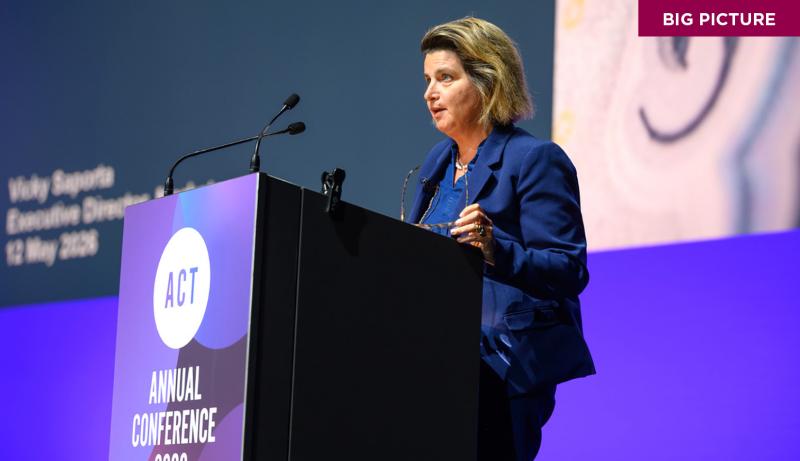
The Bank of England executive director for markets Vicky Saporta has warned corporate treasurers to prepare for a prolonged period of volatility, as geopolitical tensions, elevated borrowing costs and rapid technological change reshape the financial landscape.
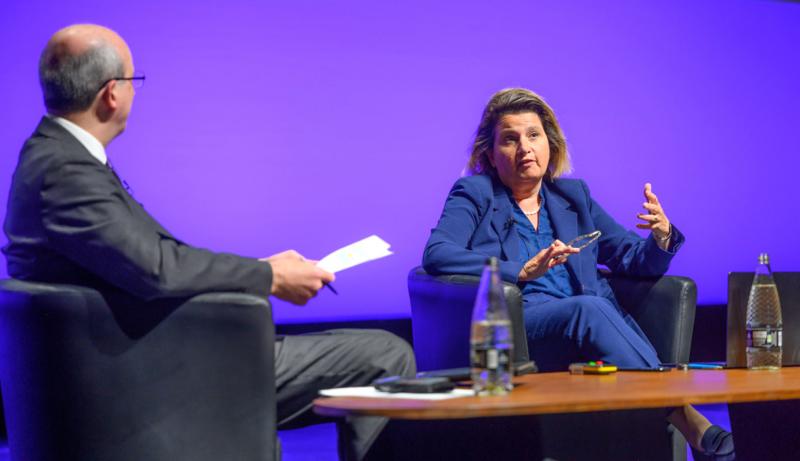
Speaking at the Association of Corporate Treasurers (ACT) Annual Conference in Liverpool on 12 May with James Winterton, ACT’s associate director for policy and technical, Saporta said treasurers should focus not only on increased funding uncertainty but also on operational resilience and emerging risks linked to artificial intelligence and cyber security.
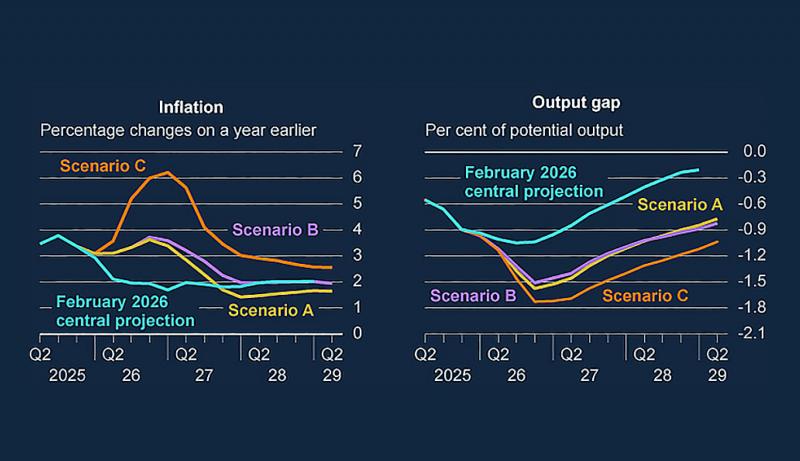
Saporta focused on the inflationary impact of renewed Middle East tensions and the risks facing sovereign debt markets. She also covered innovation in payments, tokenisation and digital assets, areas she said would materially change treasury operations in coming years. Saporta outlined three scenarios for inflation – scenarios A, B and C – that are conditioned on alternative paths for energy prices, reflecting different potential profiles for the severity and persistence of disruptions to global energy supply (see graph below).
Scenario A assumes that there are no new second-round effects as a result of the increase in energy prices, scenario B assumes higher energy prices raise short‑term inflation expectations, leading to second‑round effects, and scenario C is more severe, and so both short and long-term inflation expectations are more sensitive to persistently elevated inflation outturns and drift higher.
(Source: Bank of England Monetary Policy Report April 2026)
“Given the developments that we have, there is more uncertainty about what might be happening in terms of funding rates,” Saporta said. “Looking at your funding and looking at opportunities to raise funding, particularly in uncertain conditions, and being very thoughtful about that, is important.”
She noted that although corporate credit spreads remain “compressed”, market sentiment could shift quickly if investors became more concerned about economic resilience or sovereign debt sustainability. Corporate treasury teams, she said, could not assume current funding conditions would persist.
We are about to finalise our regime on stablecoins alongside the Financial Conduct Authority
Responding to Winterton’s question on how the Bank was supporting growth in the UK economy, Saporta reported that it was accelerating work on financial market innovation, particularly around tokenised money and digital settlement infrastructure. Saporta said the Bank had modernised its Real Time Gross Settlement (RTGS) wholesale payments system so it could align with distributed ledger technology (DLT), while also working on tokenised collateral and central bank digital currencies (CBDC).
“We are about to finalise our regime on stablecoins alongside the Financial Conduct Authority,” she said, adding that innovation in tokenised deposits and digital assets was moving rapidly.
Saporta suggested the Bank currently views a retail CBDC as more of a “backstop solution”, while private-sector innovation develops. “We will see how tokenised deposits and stablecoin get innovated in order to provide the settlement assets for what we see is going to be a lot of innovation in terms of tokenised assets, while also working on CBDC,” she said.
However, Saporta warned that technological innovation also introduces new vulnerabilities. Referencing recent advances in AI-enabled cyber tools, she highlighted concerns over “Mythos”, an AI capability designed to identify and exploit cyber vulnerabilities at speed.
“What is more threatening are innovations such as Mythos falling into bad hands,” she said. “The operational resilience debate and how technology interacts with operations is a real threat, not least because the digitalisation trend creates even more digital interdependencies.”
Saporta urged treasurers to scrutinise not only their own systems but also the resilience of their banking counterparties and payment providers. “It’s not only the financial relationship, it’s the operational relationship that is very important,” she said.
The broader backdrop remains one of heightened uncertainty. Saporta acknowledged that markets are contending simultaneously with geopolitical shocks, elevated debt levels, stretched asset valuations and growing concerns around private credit markets. Yet she stressed that UK market infrastructure had so far remained resilient despite sharp swings in gilt yields and global volatility.
Philip Smith is a business and financial journalist and former editor of The Treasurer