
After several years of balance sheet repair, deleveraging and crisis management, corporate treasurers are entering a new phase as their focus shifts from reacting to external shocks towards actively supporting growth, investment and M&A.
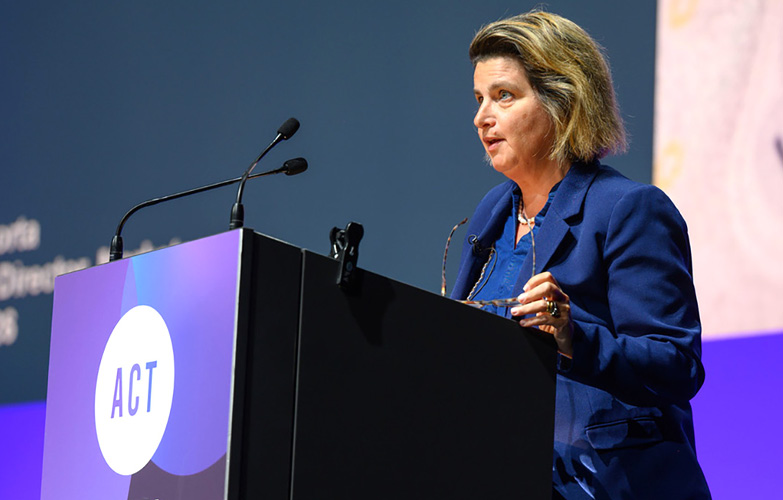
That was one of the key themes to emerge from a panel discussion at the ACT Annual Conference. While Alex Griffiths, head of EMEA Corporate Ratings at Fitch Ratings, set the scene by highlighting how many investment-grade companies have spent recent years strengthening their financial positions, the discussion quickly moved beyond ratings and leverage to examine how treasury is responding to a world defined by geopolitical tension, deglobalisation and technological disruption.
For Kate Randall FCT, group treasurer at Balfour Beatty, the war in Iran is simply the latest reminder that volatility has become permanent. “The focus is less on reacting to one individual event and more on ensuring we’re really structurally resilient as a business in what we now see as persistently volatility,” she said.
That resilience extends beyond liquidity and funding. Randall pointed to inflation-linked contracts, supply chain scrutiny and disciplined project selection as critical tools for managing long-term infrastructure projects exposed to fluctuating input costs and geopolitical uncertainty.
When you build more stocks, your supply chain is longer and suddenly your working capital is fundamentally different
For Daniel Wong FCT, group treasurer at BAT, deglobalisation has reinforced the need for treasury to understand the business at a much deeper level. He argued that companies have already learned important lessons from the pandemic, the blockage of the Suez Canal, the Russia-Ukraine conflict and disruption in the Red Sea.
“We have sourced materials differently now. We have changed our supply chain,” he said, adding that BAT has localised production in some markets to mitigate tariff risks.
Such changes have implications for treasury. Longer supply chains, higher inventory buffers and alternative sourcing strategies all affect working capital requirements. “A lot of it comes down to being part of the discussion,” Wong said. “When you build more stocks, your supply chain is longer and suddenly your working capital is fundamentally different.”
Treasury has gone from being a pretty quiet support function to really being at the heart of the action
The panel repeatedly returned to the idea that treasury must act as a business partner throughout the organisation rather than operating as a standalone financial function.
Wong described himself as “a big advocate of the treasurer being extremely embedded in the business”, with treasury involved in working capital forums, operational discussions and strategic decision-making.
Similarly, Randall said treasury’s role now stretches across investment committees, contract reviews and supply chain assessments. “Treasury has gone from being a pretty quiet support function to really being at the heart of the action,” she said.
James Kelly FCT, founder of Your Treasury and former group treasurer at Pearson, argued that treasurers are uniquely positioned to connect risk management, investor communications and board-level decision-making. During his time at Pearson, he took responsibility for enterprise risk to ensure alignment between “the debt investor relations story, the risk story and what was going to the board”.
Artificial intelligence is another area where treasury’s strategic influence is growing. Kelly rejected both the “all AI” and “no AI” scenarios, instead predicting a future of “person plus AI”. Treasury, he argued, remains too mission-critical to hand decision-making entirely to machines.
Wong echoed that view, adding that BAT has already created dedicated treasury AI specialists to explore automation, analytics and document review. The challenge now is not simply adopting AI, but ensuring data quality and governance are robust enough to support it.
Philip Smith is a business and finance journalist and former editor of The Treasurer